
Understanding Rideshare Driver Fees in Australia

Last Updated: October 25, 2026
Quick Summary
Rideshare driver fees are the platform commissions deducted from each completed trip fare. At LEFKO Rideshare, drivers pay a flat 20% service fee, meaning they retain 80% of every fare with no hidden deductions or surge-based commission changes.
- LEFKO Rideshare charges a transparent flat 20% service fee on all trips, with no variable commissions based on trip type or time of day.
- Driver earnings vary significantly by trip distance: a 5 km trip nets $14.20, a 15 km trip nets $31.80, and a 30 km trip nets $58.80 after fuel costs.
- Operating expenses including fuel, vehicle depreciation, insurance, registration, and maintenance often exceed the platform fee and significantly reduce net profit.
- Rideshare driving is treated as a business by the ATO, requiring an ABN, GST registration above the threshold, and detailed expense records for tax deductions.
- State-by-state regulations set accreditation, vehicle standards, and passenger-service levies that apply alongside the platform commission in each jurisdiction.
Table of Contents
- How Rideshare Driver Fees Work
- Understanding the Rideshare Fare Breakdown
- Platform Service Fees and Commission Deductions
- Rideshare Booking Fee: What Gets Charged
- Rideshare Driver Earnings After Fees
- Rideshare Driver Expenses Beyond Platform Fees
- Worked Examples: Fare Split and Driver Take-Home
- State-by-State Fee Variations and Regulations
- Maximising Your Earnings as a Rideshare Driver
- Frequently Asked Questions
How Rideshare Driver Fees Work
Rideshare driver fees are the platform commissions that rideshare operators take from each completed trip. Understanding how these fees work is essential for anyone considering driving with a rideshare service in Australia. At LEFKO Rideshare, we operate on a transparent flat 20% service fee model, meaning drivers retain 80% of every fare, no hidden deductions, no surge-based commission changes, no surprise platform charges that vary trip to trip.
The mechanics are straightforward: when a customer books a ride, they pay a fare that includes the base rate, distance charges, time charges, and any applicable tolls, all inclusive of GST. From that total customer payment, the platform deducts its service fee, and the remaining amount goes to the driver's weekly payout. The driver also bears their own operating costs, fuel, vehicle maintenance, insurance, and registration, which come out of their take-home earnings.
Most rideshare platforms operate differently. Some use variable commission structures tied to trip type, time of day, or driver rating. Others layer on additional charges, booking fees, cancellation penalties, or promotional deductions, that reduce what drivers actually earn. The advantage of a flat fee structure is predictability.
Understanding the Rideshare Fare Breakdown
When a customer requests a ride, the fare they see before booking includes several components. The rideshare fare breakdown typically consists of a base fare (the minimum charge to accept a trip), a per-kilometre rate (distance charge), and a per-minute rate (time charge). Australian platforms also factor in GST, which is included in the displayed fare rather than added at checkout.
Here's how a typical fare is constructed:
- Base fare: A fixed amount charged when the driver accepts the booking (e.g., $2.50-$4.00 AUD depending on the platform and location)
- Distance charge: A per-kilometre rate applied to the trip length (e.g., $1.20-$1.80 per kilometre)
- Time charge: A per-minute rate for the duration of the trip (e.g., $0.30-$0.50 per minute)
- Tolls: Actual toll costs added to the fare (applicable on motorways and toll roads)
- GST: 10% Goods and Services Tax, included in the displayed total
- Surge pricing adjustments: Some platforms apply temporary fare multipliers during high-demand periods
The customer sees a fare estimate before confirming the booking. This estimate is calculated based on current demand, traffic conditions, and the distance and time predicted by the routing algorithm.
From this total customer fare, the platform deducts its service fee. With LEFKO Rideshare's 20% flat fee, the driver receives 80% of the fare before any personal operating expenses.
Platform Service Fees and Commission Deductions
The platform service fee is the commission the rideshare operator takes from each fare. This is distinct from driver operating costs and represents the platform's revenue for providing the technology, customer support, driver vetting, insurance coordination, and payment processing.
LEFKO Rideshare charges a flat 20% service fee on every completed trip, which means why LEFKO takes a flat 20%, and drivers keep 80%. This structure is intentionally transparent: drivers know exactly what percentage they'll lose, and that percentage doesn't change based on trip type, time of day, driver rating, or surge conditions.
Other platforms may use variable commission structures. A driver might pay 15% on long trips but 25% on short trips, or face higher commissions during peak hours. Some platforms introduce additional deductions, booking service charges, driver acceptance bonuses that are later clawed back, or promotional credits that reduce driver payouts. These layered fees can make it difficult for drivers to predict their actual earnings.
Beyond the platform fee, drivers should be aware of other deductions that might appear on their statements:
- Cancellation fee reductions: If a driver cancels after accepting a trip, some platforms apply a penalty
- Promotional payouts: Driver incentives or ride bonuses that are paid out of driver earnings
- Dispute adjustments: If a customer disputes a charge, the platform may adjust the fare and reduce the driver payout
- Chargebacks: Payment disputes that result in the platform recovering funds from the driver
With a flat fee model, these additional deductions are less common. The focus remains on the core 20% commission.
Rideshare Booking Fee: What Gets Charged
Many rideshare platforms add a rideshare booking fee on top of the base fare, distance, and time charges. This is a separate line item that customers see at checkout, distinct from the fare calculation itself.
A booking fee (also called a service charge or platform fee from the customer's perspective) typically ranges from $1.00 to $3.00 AUD per trip, depending on the platform and location. This fee covers payment processing, customer support, and platform maintenance. From the driver's perspective, the booking fee is part of the total customer payment, but the driver's share of it varies by platform.
At LEFKO Rideshare, the booking fee, if applied, is included in the total fare that customers see, and the driver receives 80% of that total after the 20% platform fee.
Some platforms handle booking fees differently. They might add the booking fee after calculating the driver commission, meaning the driver's percentage applies only to the base fare, distance, and time charges, not the booking fee. This structure effectively reduces what drivers earn per trip.
Customers also encounter surge pricing adjustments during high-demand periods. When demand exceeds available drivers, fares increase by a multiplier (e.g., 1.5x or 2x the standard fare). The entire multiplied fare is subject to the platform's commission structure.
Rideshare Driver Earnings After Fees
Rideshare driver earnings after fees represent the amount drivers actually receive in their bank account after the platform deducts its service fee from the customer's fare. This is the gross earnings figure before personal operating expenses.
To calculate driver take-home from a single trip:
- Customer pays a total fare (including base, distance, time, tolls, and GST)
- Platform deducts its service fee (20% at LEFKO Rideshare)
- Driver receives the remaining percentage (80% at LEFKO Rideshare)
Example calculation:
- Customer fare: $25.00 AUD
- LEFKO platform fee (20%): $5.00 AUD
- Driver earnings: $20.00 AUD
However, driver earnings vary significantly by trip type and distance. Short trips (under 5 kilometres) often have lower absolute earnings because the base fare and time charges are smaller. Long trips (over 20 kilometres) generate higher earnings because distance charges accumulate. During surge periods, the same trip distance generates higher fares, so driver earnings increase proportionally.
see the price before you book to work out what drivers actually earn after the platform fee using LEFKO's fare calculator, which shows the full breakdown including start fee, distance, time, tolls, and driver take-home.
Weekly payouts are processed automatically, so drivers see their cumulative earnings deposited on a fixed schedule.
Rideshare Driver Expenses Beyond Platform Fees
The platform fee is the most visible deduction, but it is rarely the largest one. To understand what you actually keep, you need to separate gross fares (what the customer pays, less the platform fee) from net profit (what remains after every operating cost and tax obligation). Competitors tend to stop at the commission percentage; the fuller picture below is where the real difference between a sustainable income and a marginal one sits.
The cost stack, in rough order of impact for a typical driver:
- Fuel or energy. Petrol or electricity scales with distance. As a planning figure, many drivers work on roughly $0.10-$0.20 per kilometre for fuel, but this moves with pump prices and vehicle efficiency, track your own numbers rather than relying on a rule of thumb.
- Vehicle depreciation. Often the single largest cost and the one most drivers ignore. Every kilometre reduces resale value, and high-mileage rideshare vehicles depreciate faster than private cars. Depreciation is also a deductible expense, so recording odometer readings and purchase details matters.
- Insurance. Rideshare or commercial passenger vehicle insurance is generally required and typically costs more than private cover. Confirm with your insurer that your policy covers paid passenger trips, driving for a platform on a private policy can leave you uninsured.
- Registration and compulsory third party (CTP) insurance. Registration and CTP are state-based, and the correct registration/insurance class depends on how the vehicle is used. Check with your state regulator.
- Maintenance and tyres. Higher mileage brings forward service intervals, brake work, and tyre replacement. A maintenance reserve, setting aside a fixed amount per week, smooths these irregular costs.
- Tolls. Tolls are usually passed through in the fare, but cash-flow timing can differ, and not every trip recovers them the way you expect. Check your statement.
- Phone and data. A reliable data plan is a business cost and is generally deductible to the business-use extent.
- Platform and government charges. The platform commission plus any state passenger-service levy or per-trip charge (see the state section above).
- Tax and GST. Income tax on net profit, and GST once you are registered, see below.
Tax treatment and GST. The ATO treats rideshare driving as carrying on a business. Practically, that means:
- You generally need an ABN, and you may need to register for GST once your turnover reaches the registration threshold. GST-registered drivers charge GST on fares and can claim GST credits on business purchases, but the platform's treatment of GST on its fee affects what you can claim, so check your statements.
- Income tax is payable on net profit (assessable income less allowable deductions), not on gross fares.
- Deductible expenses commonly include fuel, maintenance, insurance, registration, depreciation, phone/data, and the platform service fee itself, apportioned for business use where an expense is mixed.
- Record keeping is not optional: keep receipts, log odometer readings, and retain platform statements. The ATO's record-keeping rules set how long records must be kept.
Fixed versus variable costs. Fuel, tolls, and some maintenance are variable, they rise with kilometres. Registration, insurance, phone plans, and any vehicle rental are largely fixed, they accrue whether you drive or not. This is why trip mix matters: longer trips spread fixed costs across more revenue, while many short trips can leave you busy but barely profitable. A driver doing high volume of short trips and a driver doing fewer long trips can post similar gross fares but very different net profit.
Vehicle ownership versus rental. If you do not own a suitable vehicle, a weekly rental or rent-to-own arrangement can consolidate registration, servicing, roadside assistance, and rideshare insurance into one predictable payment, which simplifies cash flow and removes the barrier of upfront capital. The trade-off is that a weekly rental is a fixed cost you carry even in a quiet week, so model it against your expected net fares before committing.
Australian Taxation Office, income, deductions and GST for rideshare drivers Australian Taxation Office, record keeping for business
Worked Examples: Fare Split and Driver Take-Home
Seeing how rideshare driver fees translate into actual take-home earnings helps prospective drivers understand their potential income. Here are three realistic scenarios showing the full fare split.
Scenario 1: Short Urban Trip (5 km, 12 minutes)
- Customer fare: $18.50 AUD (base $3.00 + distance $6.00 + time $5.50 + toll $4.00)
- LEFKO platform fee (20%): $3.70 AUD
- Driver earnings (before expenses): $14.80 AUD
- Estimated fuel cost: $0.60 AUD
- Net driver earnings: $14.20 AUD
Scenario 2: Medium Trip (15 km, 28 minutes)
- Customer fare: $42.00 AUD (base $3.00 + distance $18.00 + time $14.00 + toll $7.00)
- LEFKO platform fee (20%): $8.40 AUD
- Driver earnings (before expenses): $33.60 AUD
- Estimated fuel cost: $1.80 AUD
- Net driver earnings: $31.80 AUD
Scenario 3: Long Trip (30 km, 45 minutes)
- Customer fare: $78.00 AUD (base $3.00 + distance $36.00 + time $22.50 + toll $16.50)
- LEFKO platform fee (20%): $15.60 AUD
- Driver earnings (before expenses): $62.40 AUD
- Estimated fuel cost: $3.60 AUD
- Net driver earnings: $58.80 AUD
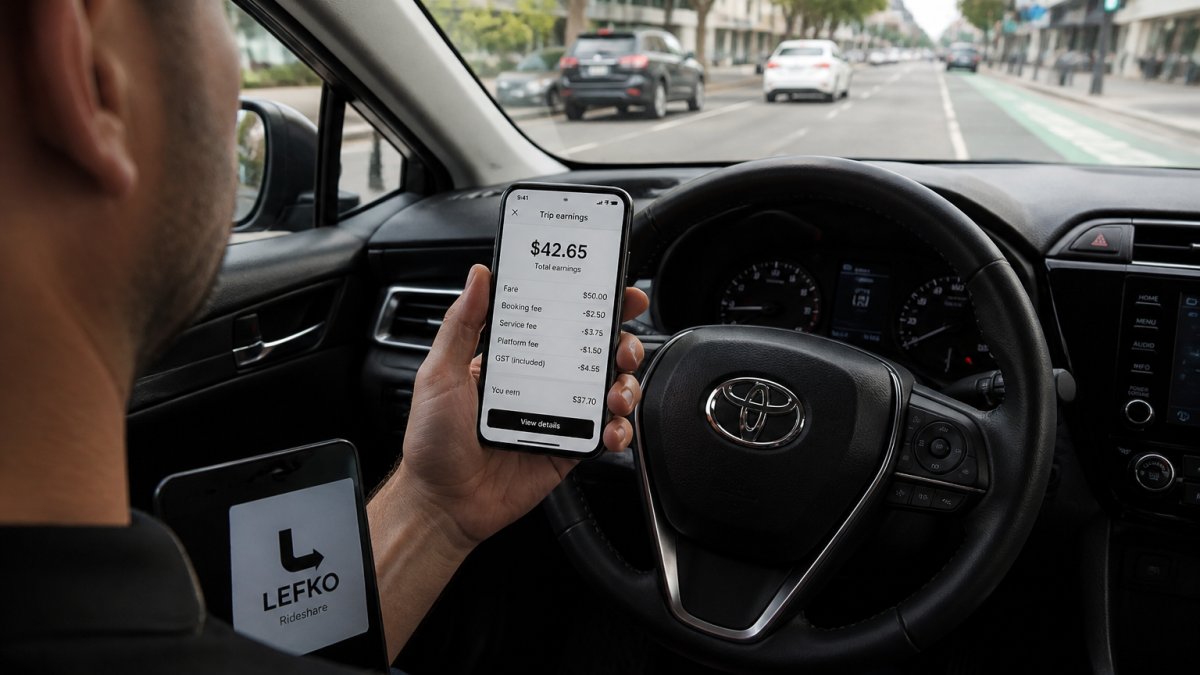
These examples show why trip mix matters. A driver completing 10 short trips earns approximately $142 in net driver earnings. The same driver completing 5 medium trips and 3 long trips earns approximately $252 in net driver earnings, a significant difference despite similar driving time.
Drivers should also factor in fixed weekly costs: vehicle rental ($150-$250), insurance ($30-$50), phone plan ($20-$30), and maintenance reserve ($20-$40). A driver earning $250 net from fares might have $200-$300 in fixed weekly costs, leaving $0-$50 in profit before tax. This is why volume and trip selection are critical.
| Trip Type | Distance | Customer Fare | Platform Fee (20%) | Driver Earnings | Fuel Cost | Net Earnings |
|---|---|---|---|---|---|---|
| Short | 5 km | $18.50 | $3.70 | $14.80 | $0.60 | $14.20 |
| Medium | 15 km | $42.00 | $8.40 | $33.60 | $1.80 | $31.80 |
| Long | 30 km | $78.00 | $15.60 | $62.40 | $3.60 | $58.80 |
State-by-State Fee Variations and Regulations
Rideshare rules are set at state and territory level, not nationally. That means the regulator, the accreditation or licence a driver needs, the vehicle standards, and the passenger-service levy or fee that applies can all differ depending on where you drive. Platforms generally set their own commission rates, there is no national statutory cap on the percentage a platform may deduct, but the surrounding compliance costs and levies do vary.
| Jurisdiction | Main regulator / framework | Key driver requirements to verify |
|---|---|---|
| New South Wales | Point to Point Transport Commissioner (Passenger Transport Act 1990) | Driver authority, vehicle registration and CTP insurance class, vehicle inspection |
| Victoria | Commercial Passenger Vehicles Victoria (Commercial Passenger Vehicle Industry Act 2017) | Driver accreditation, commercial passenger vehicle registration, vehicle standards |
| Queensland | Department of Transport and Main Roads (Transport Operations (Passenger Transport) Act 1994) | Driver authorisation, booked hire service licence, vehicle safety |
| Western Australia | Department of Transport (Transport (Road Passenger Services) Act 2018) | Driver and vehicle authorisation, on-demand booking service rules |
| South Australia | Department for Infrastructure and Transport (Passenger Transport Act 1994) | Accreditation, vehicle standards, chauffeur/rideshare authorisation |
| Tasmania | Department of State Growth (Passenger Transport Services Act 2011) | Driver and vehicle accreditation, rideshare-specific conditions |
| Australian Capital Territory | Access Canberra (Road Transport (Public Passenger Services) Act 2001) | Rideshare driver accreditation, vehicle registration, inspection |
| Northern Territory | Department of Infrastructure, Planning and Logistics (Commercial Passenger Vehicles Act 1995) | Commercial passenger vehicle licence, driver accreditation |
Passenger-service levies and per-trip charges. Several jurisdictions impose a levy or per-trip charge on passenger services, which is separate from the platform's commission. In New South Wales, for example, a passenger service levy applies to point-to-point transport services, and the rate and scope are set by the state, check the Point to Point Transport Commissioner for the current amount and which trips it covers. Because these levies are typically collected through the platform and passed on, they can appear as a line item that reduces the amount a driver ultimately receives, even though they are not the platform's own fee. Always read your statement to see whether a deduction is a platform commission, a government levy, or a pass-through charge such as a toll.
What is not regulated at state level. Fuel excise and road-user charging are set nationally, and the Australian Taxation Office (ATO), not the state transport regulator, governs how rideshare income is taxed. The ATO treats rideshare drivers as carrying on a business for tax purposes in most cases, which means you generally need an Australian Business Number (ABN), may need to register for GST once your turnover reaches the threshold, and must keep records of income and expenses.
Why this matters for fees. A platform's headline commission is only one deduction. Accreditation fees, vehicle inspection costs, registration and CTP/insurance classes, and any state passenger-service levy all sit alongside the platform fee in your real cost base. When you compare platforms, compare the total deduction per trip, platform commission plus any levy or pass-through charge, rather than the commission percentage alone.
Point to Point Transport Commissioner (NSW), driver authority and passenger service levy Commercial Passenger Vehicles Victoria, driver accreditation Australian Taxation Office, rideshare and taxi drivers
Maximising Your Earnings as a Rideshare Driver
Earning a sustainable income as a rideshare driver requires strategy beyond simply accepting every available trip. Several practical approaches help drivers optimise their take-home earnings within the platform fee structure.
Prioritise longer trips. Longer trips generate higher absolute earnings and spread fixed costs (vehicle depreciation, registration) across more revenue.
Minimise short-trip acceptance. Short trips under 5 kilometres often have poor profitability after expenses. Base fares and time charges don't scale down proportionally, so a 2-kilometre trip might earn $8 before expenses, barely covering fuel and wear. Selective acceptance of trip requests improves overall earnings efficiency.
Drive during peak demand periods. Surge pricing multipliers apply to the entire fare, including the base, distance, and time charges. A trip that normally earns $30 might earn $45 during surge (1.5x multiplier).
Maintain a high driver rating. Platforms reward highly-rated drivers with priority access to premium trips, longer routes, and surge-priced fares. Consistent 4.8+ ratings often unlock bonus opportunities or preferential matching algorithms that steer higher-value trips toward reliable drivers.
Track expenses meticulously. Accurate expense records allow drivers to maximise tax deductions, reducing taxable income. Fuel, maintenance, insurance, registration, phone plans, and vehicle depreciation are all deductible.
Consider vehicle rental options. Become a LEFKO driver and explore rent-to-own or weekly rental programs.
Monitor your platform fee structure. Platforms with variable commission rates penalise drivers on short trips or off-peak periods. LEFKO's flat 20% fee removes this variability, ensuring consistent earnings proportions regardless of trip type.
The difference between a sustainable rideshare income and a marginal one often comes down to trip selection, driving during peak periods, and understanding the full cost picture.
Understanding rideshare driver fees is the foundation for making an informed decision about joining a platform. The fee structure determines your earnings potential, and the total cost picture, platform fee plus operating expenses, determines your actual profitability.
Frequently Asked Questions
How much of a rideshare fare does the driver receive?
Driver take-home depends on the platform's service fee structure and any booking charges applied to the trip. On LEFKO, drivers retain 80% of the fare after the flat 20% service fee is deducted. Other costs, fuel, maintenance, insurance, reduce net earnings further. A $50 fare with a 20% fee leaves $40 before vehicle expenses, which typically range from $8-$15 per trip depending on distance and fuel consumption.
What fees are deducted from a rideshare driver's fare?
The primary deduction is the platform's service fee, which covers operations, insurance, and payment processing. LEFKO charges a flat 20% service fee with no hidden deductions. Some platforms vary fees by trip type or location. Booking fees, charged separately to customers, are distinct from the service fee. Drivers also face GST obligations if they earn above the tax-free threshold.
How do rideshare driver expenses affect my net earnings?
Operating costs significantly reduce take-home pay. Typical rideshare driver expenses include fuel, vehicle maintenance, comprehensive insurance, and registration. Tracking these expenses is essential for tax deductions and understanding true profitability.
Are booking fees and service fees the same thing?
No. A service fee is the platform's commission deducted from the driver's fare, on LEFKO, this is 20%. A booking fee is a charge added to the customer's total fare; it covers payment processing and platform operations. Customers see both charges in their receipt, but only the service fee affects driver earnings. Understanding this distinction helps drivers calculate accurate take-home pay per trip.
How can I verify the fees deducted from each trip?
Most rideshare platforms, including LEFKO, provide a detailed trip receipt showing the gross fare, platform service fee, and net driver payout. Check your earnings history in the app after each trip. Compare the advertised fare to your payment to ensure accuracy. If a deduction seems incorrect, contact driver support with the trip ID and receipt. Keeping records of weekly payouts helps identify patterns and spot billing errors early.
Do rideshare driver fees vary between trips or platforms?
Yes. Fees can vary by trip type (short vs. long distance), time of day, location, and platform. LEFKO uses a consistent flat 20% service fee across all trips, providing predictability. Other platforms may charge variable percentages or add surge-related adjustments. State regulations also differ. Comparing platforms' fee structures in your area helps identify which offers the best take-home earnings for your driving patterns.
What tax and record-keeping obligations do rideshare drivers have?
Rideshare drivers are classified as independent contractors and must register for GST if annual turnover exceeds the threshold. All income must be declared to the Australian Taxation Office. Keep records of fares, expenses (fuel, maintenance, insurance, vehicle depreciation), and platform payments for tax purposes. Deductible expenses reduce taxable income, often significantly. Consult an accountant familiar with gig economy work to optimise your tax position.
How do I calculate my true hourly earnings as a rideshare driver?
True hourly earnings require subtracting all operating costs from gross fares, then dividing by hours worked. This is before tax. Factor in downtime between trips, cancellations, and vehicle depreciation. Track these metrics weekly to assess viability in your area.
