
AI IN VEHICLES...THE TIP OF THE ICEBERG
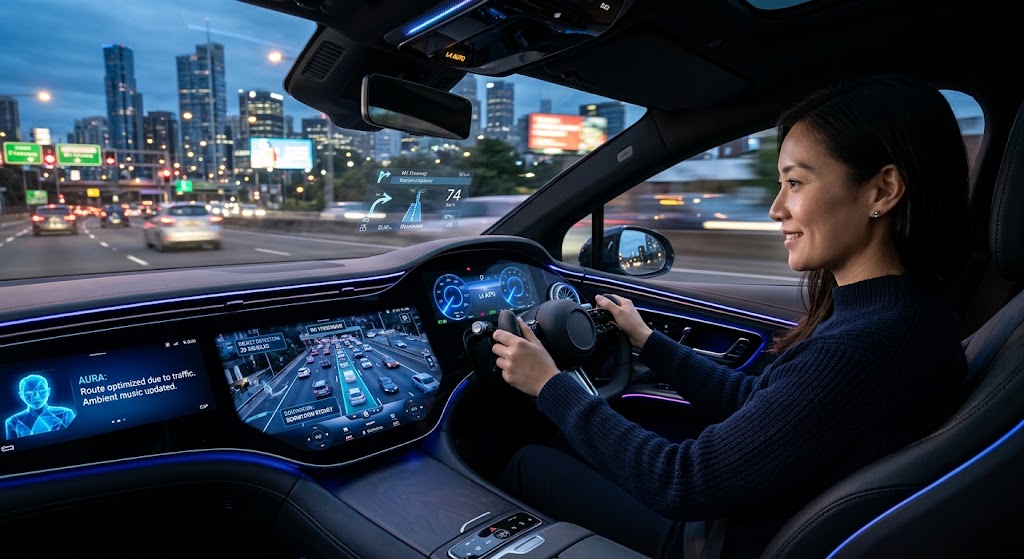
Imagine stepping into your car, not by sliding behind a wheel you have to hold every second, but by sinking into a mobile living room that knows your name, your schedule, and how warm you like your seat.
We aren't quite living in a sci-fi movie where you can fall asleep on the way to work and wake up at the office—fully driverless, "go-anywhere" vehicles are still a distant dream. But right now, the relationship between human and machine is undergoing its biggest rewrite in a century.
Here is how the story of the intelligent automobile is unfolding on our roads.
- The Quiet Hand-Off on the Highway For years, cruise control just kept your speed steady. Then came lane-assist to keep you from drifting. Today, we’re witnessing a major shift: the car is actively taking the reins.
Hands-free driving isn't a rare luxury anymore—it’s becoming the standard. On highways across the globe, millions of drivers are already letting their cars steer, brake, and navigate highway traffic on their own. In select cities, early adopters are sitting in vehicles that handle the entire drive conditionally, allowing the driver to legally take their eyes off the road for moments at a time.
Meanwhile, if you call a ride in places like San Francisco or Wuhan, there’s a good chance nobody is sitting in the driver’s seat at all. Fleet robotaxis are already quietly clocking over 700,000 driverless passenger trips every single week.
- Electric Dreams: The New Brain Needs a New Body You can’t easily put a futuristic, supercomputing brain into an old, oil-dripping combustion engine. That’s why the electric vehicle (EV) has silently become the hero of this story.
EVs aren't just about saving gas; they are massive batteries on wheels with simple, digitized mechanical backbones. They provide the raw electric power needed to run complex AI processors, cameras, and radar networks without breaking a sweat. In fact, every single commercial robotaxi navigating city streets today runs on electric power.
- The Car That Learns While You Sleep Remember when a car began aging the exact moment you drove it off the dealership lot? That era is ending.
The vehicles hitting the road today are "software-defined." Like your smartphone, they wake up periodically with over-the-air updates. You might go to sleep on a Tuesday and wake up on Wednesday to find your car has learned a smarter parallel parking trick, gained a couple of miles of battery range, or updated its digital voice assistant to sound remarkably human. The car you own three years from now will actually be better than the day you bought it.
- A Shift in the Car Maker’s Playbook Behind the factory doors, the entire process of building a car is being re-imagined. Designers use AI to craft lighter, safer vehicle frames, while factory algorithms predict when a machine on the assembly line needs maintenance before it ever breaks down.
For automakers, the financial playbook is flipping completely. Cars are morphing into digital platforms. Auto executives used to make their money solely on the one-time sale at the dealership; now, they are preparing for a world where drivers subscribe to high-tech features, upgraded driving assistance, or personalized in-cabin entertainment as needed.
- The Roadblocks Ahead As fast as the technology is moving, the human world is taking a beat to catch up.
Navigating a chaotic downtown street filled with unpredictable pedestrians, sudden rainstorms, and confusing roadwork requires near-flawless precision. Regulators, safety boards, and car manufacturers are pacing themselves. They know that to win public trust, these systems can't just be convenient—they have to be undeniably safer than a human driver. Because of this, the rollout for total hands-off, mind-off driving is a marathon, not a sprint.
What This Means when You Grab Your Keys Your car is no longer just a piece of hardware that gets you from Point A to Point B. It’s evolving into an intelligent companion.
In the coming years, your vehicle will read the road, anticipate your needs, update its own brain overnight, and handle the most exhausting parts of your daily commute. We may not have flying cars just yet, but the vehicle parked in your driveway is getting ready to do a whole lot more of the driving for you.