
Are Rideshare Fares GST Inclusive? A Driver and Rider Guide

Last Updated: October 26, 2026
Quick Summary
Rideshare fares GST inclusive in Australia means the fare you see already includes the 10% Goods and Services Tax. When you see a fare estimate on your app, that price already includes tax and you won't pay extra at the end of the ride.
- The fare displayed is GST-inclusive; no additional tax is added at checkout
- GST is calculated as one-eleventh of the total fare, not 10% added on top
- Drivers must report the full passenger fare as taxable income, not just their net payout after commission
- Platform commissions are also GST-inclusive and carry their own input tax credit
- Keep platform statements and receipts for five years to reconcile your BAS with earnings
Table of Contents
- Are Rideshare Fares GST Inclusive or Exclusive?
- GST on Rideshare Fares: What Passengers Actually Pay
- Reading Your Rideshare GST Receipt
- GST Registration for Rideshare Drivers
- Using a Rideshare GST Calculator for Income and Expenses
- Reporting Rideshare Income on Your Business Activity Statement
- Frequently Asked Questions
Are Rideshare Fares GST Inclusive or Exclusive?
Yes, rideshare fares GST inclusive in Australia means the fare you see already includes the tax.
This matters for both riders and drivers. Passengers know their final cost upfront, while drivers need to understand how GST affects earnings and tax obligations.
The key point: rideshare fares are GST-inclusive, not exclusive, unlike services where GST is added on top. Understanding this helps you budget correctly and manage your finances as a driver.
GST on Rideshare Fares: What Passengers Actually Pay
When a rideshare app shows a fare of $25, that's the total you'll pay, the $25 already includes GST.
Here's how it works in practice:
- The fare displayed includes the 10% GST
- No surprise charges appear after you book
- The driver's payout is calculated from this GST-inclusive amount
Passengers benefit from this clarity. You know exactly what the ride costs before you confirm. No hidden fees.
For drivers, the GST-inclusive model means the full passenger fare is the taxable supply.
Here's how GST works on rideshare fares and what it means for your final cost and tax obligations.
| Item | Value | Note |
|---|---|---|
| Fare display | GST inclusive | Price shown is total you pay |
| GST rate | 10% | Built into fare, not added after |
| GST calculation | One-eleventh of fare | Divide by 11, not multiply by 10% |
| Example fare | $25.00 | Includes $2.27 GST |
| Driver's taxable supply | Full passenger fare | Not just driver's take-home portion |
| Platform commission | 20% of fare | Also GST-inclusive |
| Driver payout example | $20.00 gross | From $25 fare after 20% commission |
Reading Your Rideshare GST Receipt
Your rideshare receipt should show the full fare and break down the GST component. Look for:
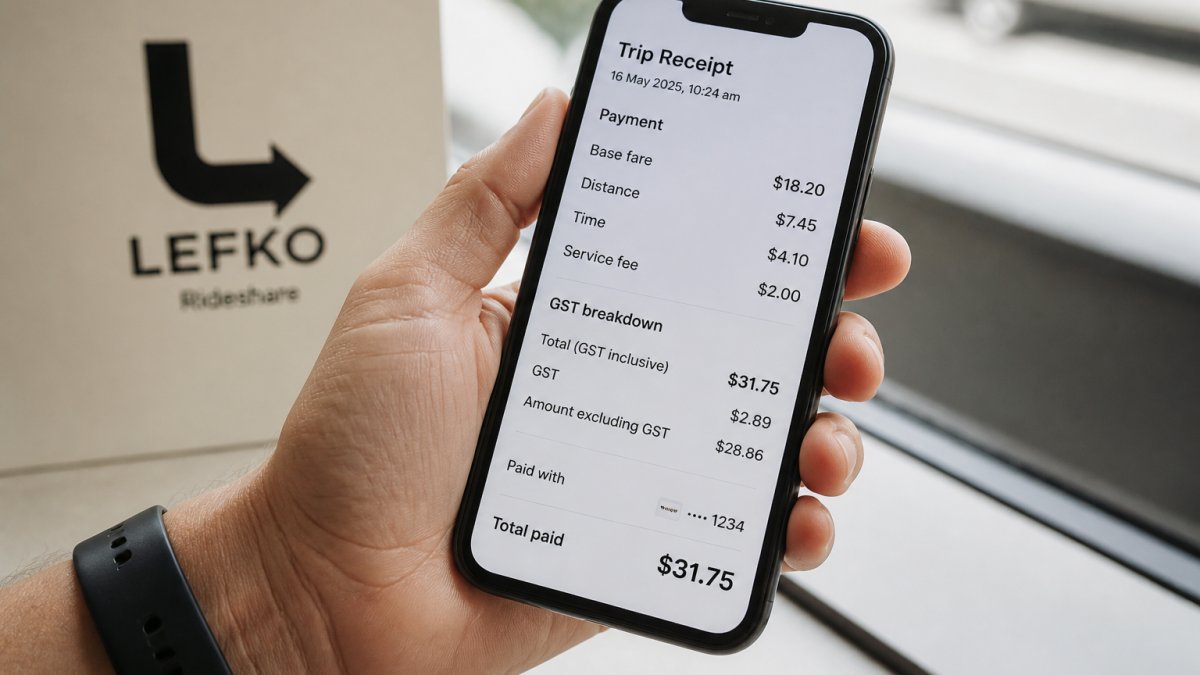
- Total fare: The amount you paid (GST inclusive)
- GST amount: Usually shown as one-eleventh of the total fare
- Service date: When the ride occurred
The GST component is one-eleventh of the total fare. If your fare is $22, the GST portion is approximately $2, already built into the total, not added on top.
Why this matters: if you're claiming work-related travel expenses, your receipt shows the GST you can potentially recover through input tax credits (if registered for GST). Keep receipts for all trips you plan to claim.
GST Registration for Rideshare Drivers
If you drive for a rideshare platform, GST registration affects your income and tax reporting.
You must register for GST if your annual turnover reaches the registration threshold, based on total fares collected.
The full passenger fare is your taxable supply.
Here's the practical flow:
- Passenger pays $30 (GST inclusive)
- You receive $24 (your 80% share after the platform's 20% fee, before tax)
- The $30 fare is your taxable income for GST purposes
ATO guidance on GST registration thresholds
When you register, you can sign up to drive with LEFKO and understand how the 20% platform fee works alongside your GST obligations.
Using a Rideshare GST Calculator for Income and Expenses
A GST calculator is only useful if it separates the three amounts tangled together on a rideshare trip: the GST built into the passenger fare, the platform's commission, and the GST built into that commission. Most drivers who get this wrong work from the net payout figure instead of the gross fare.
The rule to anchor everything: the full passenger fare is the taxable supply. GST is one-eleventh of a GST-inclusive amount, so divide the fare by 11, not multiply by 10%.
Worked example: $25 fare, 20% commission
- Passenger fare (GST inclusive): $25.00
- GST on the fare (one-eleventh): $2.27
- Platform commission (20% of fare): $5.00
The $18.18 is the figure that matters for cash-flow planning, not the $20.00 payout, and not the $17.73 you get if you ignore the commission credit. That $0.45 difference per trip compounds across a quarter.
Worked example: a quarter of trips
Take 400 trips at an average $22 fare, 20% commission, and $1,200 of eligible expenses (fuel, maintenance, phone) carrying $109 of GST:
- Total fares: $8,800.00
- GST on fares (one-eleventh): $800.00
- Platform commission (20%): $1,760.00
That is the number that goes on the BAS. The common error is reporting only the $7,040 net payout as sales and remitting $640, understating both sales and GST, and creating a mismatch the ATO can pick up when it data-matches platform statements.
What to put in the calculator
A practical calculator needs four inputs, not two:
- Gross passenger fare (GST inclusive)
- Platform commission rate
- Whether the platform charges GST on the commission (most do)
- Eligible expense GST for the period
Output should be: GST on fares, GST credit on commission, GST credit on expenses, and net GST payable. If a calculator only outputs "GST = fare ÷ 11", it is giving you one-third of the picture.
ATO guidance on calculating GST and input tax credits
You can see the price before you book using LEFKO's fare calculator, which shows GST-inclusive estimates. For drivers, the same fare figure is the starting point for the calculation above, the fare does not change, only how you report it.
Reporting Rideshare Income on Your Business Activity Statement
Your BAS is where the fare-level arithmetic becomes a single set of labels. The practical challenge is reconciling platform statements, commission charges and expense records into figures that tie out. A BAS that does not reconcile to the platform's annual statement is the most common trigger for a follow-up question.
The reconciliation workflow
Work in this order each reporting period:
- Download the platform's tax summary or earnings statement for the period. This is your primary record of gross fares.
- Record gross fares as total sales (GST-inclusive). Do not net off commission here. The full fare is the taxable supply.
- Record GST on sales as one-eleventh of gross fares.
- Record the platform commission as an expense, and claim the GST component (one-eleventh of the commission) as an input tax credit.
- Add eligible expense GST from fuel, maintenance, insurance, phone and similar records.
- Calculate net GST as GST on sales minus GST credits on commission and expenses.
- Retain the platform statement, commission invoices and expense receipts for five years.
Worked BAS example
Using the same quarter as above, 400 trips, $22 average fare, 20% commission, $1,200 eligible expenses with $109 GST:
- G1 Total sales: $8,800.00
- 1A GST on sales: $800.00
- G11 Non-capital purchases (commission + expenses): $1,760.00 + $1,200.00 = $2,960.00
The sales figure is $8,800, not the $7,040 you actually received. That gap is the single most common BAS error for rideshare drivers, and it is the one the ATO's data-matching against platform reports is most likely to surface.
Common scenarios and how they land on the BAS
- Cancellations and no-shows: If the platform pays you a cancellation fee, treat it as part of your taxable supplies. If the passenger is refunded and you receive nothing, there is no supply and nothing to report.
- Tips: Tips paid through the platform are generally part of the fare for GST purposes. Tips paid in cash outside the platform are a separate question and should be recorded separately.
- Tolls and surcharges: If a toll is included in the fare the passenger pays, it is part of the GST-inclusive fare. If you pay the toll yourself and are reimbursed, the treatment depends on whether the reimbursement is part of the fare.
ATO Business Activity Statement instructions
ATO record-keeping requirements for GST
Keep invoices and receipts for all business expenses. Fuel, vehicle maintenance, insurance and phone bills related to driving are typically deductible, and the GST on them is claimable to the extent of business use. Accurate record-keeping makes BAS filing straightforward and protects you if the ATO reviews your return.
Frequently Asked Questions
Are rideshare fares GST inclusive?
Yes, rideshare fares shown on most platforms, including LEFKO, are GST-inclusive. This means the total fare displayed already includes the 10% Goods and Services Tax. When you book a ride, the estimate you see is the full amount you'll pay. Your tax invoice will break down the GST component separately, showing the net fare and the GST charged.
Do rideshare drivers need to register for GST?
Rideshare drivers must register for GST with the Australian Taxation Office if their annual turnover exceeds the GST registration threshold (currently $75,000). Once registered, drivers must charge GST on fares and report it in their Business Activity Statement (BAS) each quarter. Even below the threshold, drivers can choose to register voluntarily to claim input tax credits on eligible vehicle expenses.
How do I calculate GST on a rideshare fare?
To calculate GST from a GST-inclusive fare, divide the total by 11 to find the GST component. For example, a $55 fare contains $5 GST ($55 ÷ 11 = $5). Alternatively, multiply the GST-exclusive amount by 10% to find the tax. If you're a driver tracking income, a rideshare GST calculator helps separate the net fare from platform commission and GST owed, simplifying BAS reporting.
Can I claim GST credits on rideshare vehicle expenses?
If you're registered for GST as a rideshare driver, you can claim input tax credits on eligible business expenses like fuel, vehicle maintenance, and insurance, provided you have a valid tax invoice. GST credits reduce the GST you owe the ATO. Keep all receipts and invoices. Your accountant or a rideshare GST calculator can help identify which expenses qualify and ensure accurate BAS reporting.
Understanding GST as a rideshare driver means knowing that passengers pay GST-inclusive fares, you must report the full fare as taxable income, and you claim input tax credits for eligible expenses. Become a LEFKO driver to access transparent fare calculations, weekly payouts, and support for managing your tax obligations. Learn why LEFKO takes a flat 20% and drivers keep 80% of every fare, a straightforward model that makes GST and income tracking simpler.
